
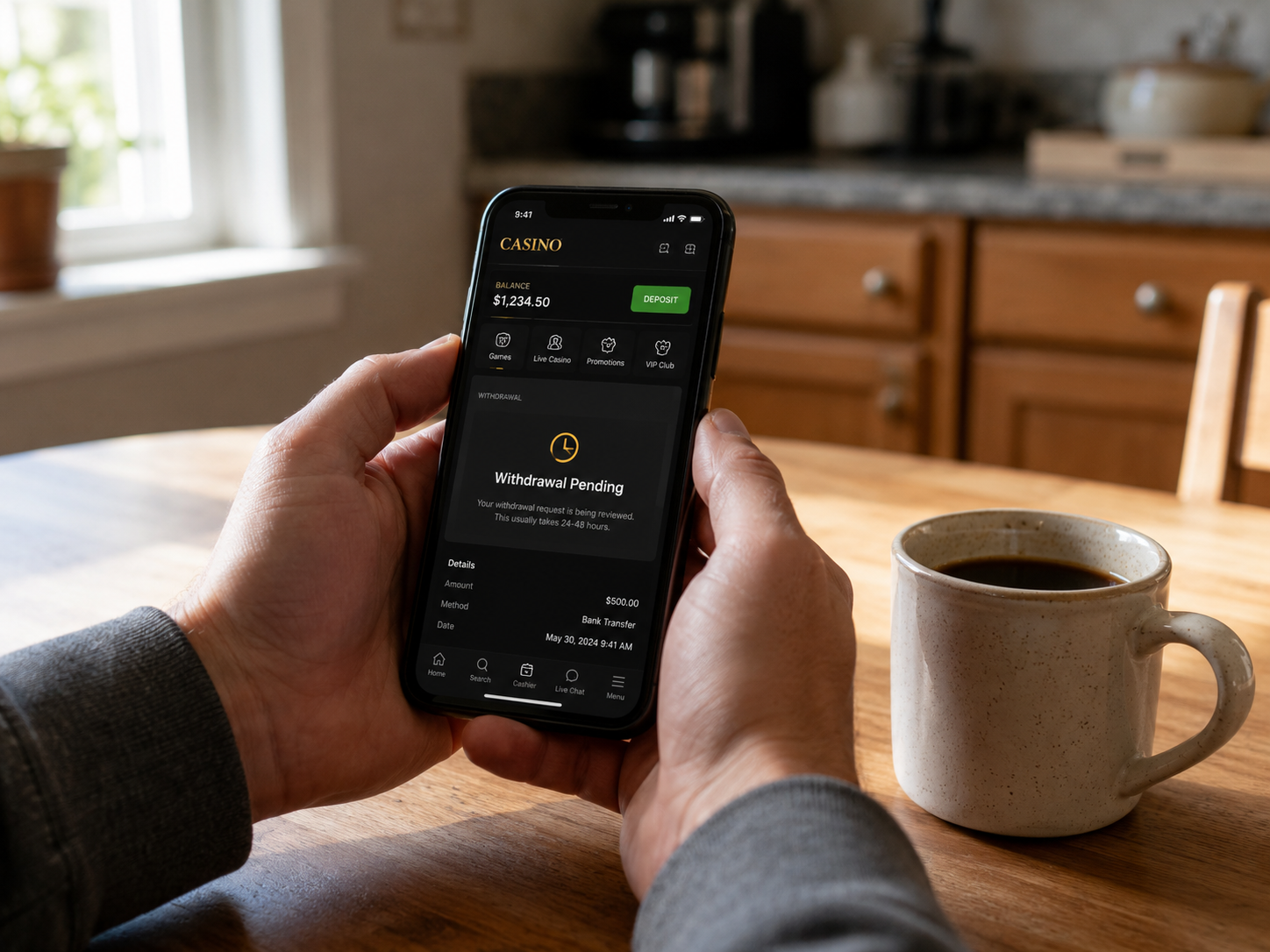
What a “fast” casino withdrawal really means
When a casino advertises fast payouts, the clock usually starts ticking at two separate points: the operator’s internal approval and the payment provider’s processing time. These are different stages, and confusing them is the most common source of frustration.
| Stage | What happens | Typical range |
|---|---|---|
| Operator approval | The casino checks your KYC status, bonus terms, and withdrawal limits, then authorises the payout | Minutes to 48 hours |
| Payment-rail settlement | The funds travel through the banking or e-wallet network to your account | Instant (e-wallets, crypto) to 3–5 business days (bank transfer) |
A casino can approve a withdrawal in ten minutes, but if you chose a bank transfer, settlement still takes days. Conversely, a slow internal review paired with an instant e-wallet means you wait for the approval, not the payment itself.
Comparison pages that focus on withdrawal speed for Canadian players typically separate these stages and also note limits and supported methods. For a practical example of how payout time, limits, and payment methods are organized side by side, CasinoCanada’s guide to fast payout online casinos breaks withdrawal speed out from other cashout conditions. This kind of breakdown helps you understand whether a “fast” label refers to approval, settlement, or both.
Key distinction: Ontario’s AGCO funds-management standard specifies that withdrawals depend on appropriate verification and authorization. In practice, “fast” should never be read as “unchecked.” Even the quickest operators still run compliance steps before releasing funds.
Why casinos verify identity before paying out
Identity verification isn’t an obstacle the casino invented to slow you down. It exists because gambling operators are legally required to confirm who their customers are, and that obligation only gets stricter at the point of withdrawal.
The reasons boil down to a few core obligations:
- Age confirmation — ensuring the player is legally old enough to gamble.
- Account ownership — confirming the person requesting funds is the one who created and funded the account.
- Fraud prevention — catching duplicate accounts, stolen payment methods, or suspicious patterns.
- Anti-money laundering (AML) — meeting federal requirements around large or unusual transactions.
In Canada, FINTRAC’s casino guidance ties identity verification to a range of triggers: disbursements, large cash or virtual-currency transactions, suspicious activity, electronic funds transfers, and various account-related obligations. So when a casino asks you to upload ID before releasing a payout, it’s often fulfilling a legal obligation rather than creating an arbitrary hurdle.
For Ontario players specifically, the regulated operator journey starts even earlier. iGaming Ontario’s player guide explains that regulated sites collect personal information and verify identity before account creation, with a digital wallet used for deposits and withdrawals. That means if you’re playing on a licensed Ontario platform, some verification has already happened at sign-up.
KYC, AML, and the checks that slow things down
KYC (Know Your Customer) and AML (Anti-Money Laundering) are the regulatory frameworks behind identity checks. In day-to-day terms, they translate into a handful of common delays:
- Name mismatch — your account name doesn’t match the name on your payment method or ID document.
- Expired or unclear ID — the document you uploaded is out of date, blurry, or cropped.
- Address discrepancy — your registered address doesn’t match what’s on file with the payment provider.
- Flagged transaction pattern — rapid deposits and withdrawals, large sums, or unusual play patterns trigger a closer look.
- Source-of-funds request — for larger amounts, the casino may ask how the deposited funds were obtained.
Worth knowing: As FINTRAC’s casino identification guidance makes clear, these checks aren’t optional add-ons. They’re tied directly to disbursement triggers and account obligations under Canadian law. Completing verification accurately the first time is the single best way to avoid delays.
How to withdraw money from an online casino
The process itself is straightforward once your account is in good standing. Here’s what the typical withdrawal flow looks like, step by step:
- Log in and navigate to the cashier, banking, or wallet section.
- Check your available balance — some funds may be locked in active bonuses or pending wagers.
- Confirm bonus terms are cleared — if you accepted a deposit bonus, the wagering requirements must be fully met before you can withdraw the associated funds.
- Verify your KYC status — if the site shows a pending verification flag, upload the required documents before requesting a payout.
- Choose a withdrawal method — pick one that supports withdrawals (not all deposit methods do).
- Enter an amount within limits — stay above the minimum and below the maximum per-transaction, daily, weekly, or monthly cap.
- Submit the request and save or screenshot the confirmation.
- Monitor your email and account messages — if the casino needs anything else, you’ll typically get a notification.
If you’re unsure about specific limits or which payment options are available, fast-payout comparison guides often list withdrawal caps and methods per operator, which can save time before you commit to a cashout.
Pre-withdrawal checklist
Before you hit the withdraw button, run through this list to catch the issues that cause 90% of avoidable delays:
☐ Account name matches the name on your ID and payment method
☐ Email and phone are verified in account settings
☐ All bonus wagering requirements are complete
☐ Chosen payment method supports withdrawals (not just deposits)
☐ Withdrawal amount falls within posted min/max limits
☐ No active disputes or chargebacks on the account
☐ Responsible-gambling deposit or loss limits won’t conflict with the withdrawal
Common trap: Prepaid cards and certain voucher methods frequently allow deposits but cannot receive withdrawals. If you deposited with a prepaid Visa, for example, the casino will ask you to select an alternative method for your payout, which adds an extra step and potentially an extra verification round.
Payment methods and timing: Interac, e-wallets, bank transfers, and crypto
Even after the casino approves your withdrawal, the funds still need to travel through a payment network. The method you chose at deposit time (or select at withdrawal) has a direct impact on how quickly you receive the money.
| Method | Typical settlement | Notes |
|---|---|---|
| E-wallets (PayPal, Skrill, Neteller, MuchBetter) | Minutes to a few hours | Usually the fastest option once approved; some casinos process e-wallet withdrawals ahead of other methods |
| Interac e-Transfer | Minutes to same day | Popular in Canada; Interac’s business platform offers immediate confirmation and limits up to $25,000 depending on conditions |
| Cryptocurrency | Minutes (network-dependent) | Fast settlement, but blockchain congestion and casino processing time still apply |
| Debit/credit card refund | 1–5 business days | Processed as a refund or bank credit; timing depends on the issuing bank |
| Bank (wire) transfer | 3–5 business days | Typically the slowest option; often used for larger amounts that exceed e-wallet limits |
This is why two players at the same casino can have completely different withdrawal experiences. One chooses an e-wallet and sees funds within hours; the other uses a bank transfer and waits nearly a week. Both timelines can be perfectly normal.
Practical tip: If speed matters, check which withdrawal methods are available before you deposit. Depositing via bank transfer and then requesting a payout to an e-wallet may trigger additional verification, since the casino typically wants funds to return through the same channel they arrived.
Can a casino refuse to pay out?
The short answer is: yes, under certain conditions. But “refuse” covers a range of situations, and it’s important to distinguish between a permanent refusal, a temporary hold, and a routine review.
Common reasons withdrawals are held or declined
- Incomplete identity verification — documents haven’t been submitted or didn’t pass review.
- Name mismatch — the account holder’s name doesn’t match the withdrawal method.
- Unmet wagering requirements — bonus funds or winnings tied to a bonus haven’t been played through.
- Bonus abuse flags — patterns that suggest terms were exploited (e.g., minimal play on low-risk games to meet wagering).
- Duplicate accounts — multiple accounts from the same person violate most operators’ terms.
- Unsupported withdrawal method — the chosen method doesn’t accept incoming transfers.
- Amount exceeds limits — the request is above the daily, weekly, or monthly maximum.
- Suspicious activity review — irregular patterns triggered an internal or regulatory check.
- Self-exclusion or account closure — the player activated a responsible-gambling restriction.
Most of these are resolvable. A name mismatch takes a support ticket. Unmet wagering takes time (or a decision to forfeit the bonus). An unclear ID takes a re-upload.
Where things get more serious is when a casino holds funds without clear communication or cites vague “security” reasons for extended periods. In a regulated market, operators are expected to follow specific standards around fund management and verification. FINTRAC’s requirements and AGCO’s funds-management rules both establish that verification and authorization come before disbursement, but they also imply the process should be defined and transparent.
What Ontario players should check before escalating a payment issue
If your withdrawal has been stuck for longer than the operator’s stated processing time, resist the urge to immediately file a complaint. A structured approach saves time and produces better outcomes.
- Check operator messages — look for emails, in-app notifications, or account alerts asking for additional documents.
- Re-read the terms and conditions — confirm your withdrawal amount, method, and bonus status all comply.
- Verify the posted timeline — compare the operator’s stated processing window with how long you’ve actually been waiting.
- Contact support — use live chat or email and ask for a specific reason and expected resolution time.
- Request a complaint reference number — if the issue isn’t resolved in the first contact, a reference number creates a documented trail.
- Keep screenshots — save confirmation screens, chat transcripts, and email correspondence.
- Confirm the operator is regulated — if you’re in Ontario, check that the site is listed on iGaming Ontario’s registered operator list.
iGaming Ontario’s player support page lists payout amount, payment handling, terms, bonus offers, ID verification, and account closure among the issues players can raise with a regulated operator. If your site is not regulated under iGaming Ontario, the available support options may be more limited.
Important: Filing a chargeback with your bank before working through the casino’s complaint process can backfire. Many operators treat chargebacks as fraud indicators, which can freeze your entire account and make it harder to resolve the original issue.
Key takeaways
Withdrawals are the moment that reveals how fairly a casino actually treats its players. Most delays come down to formalities — incomplete verification, a payment method that doesn’t support payouts, or unmet bonus conditions — rather than bad faith on the operator’s side. The points below cover what to get right from the start to keep your payouts smooth.
- Verify early. Complete identity checks as soon as you create your account, not when you’re ready to withdraw.
- Choose your payment method with withdrawals in mind. Not every deposit method supports payouts, and settlement times vary dramatically.
- Read bonus terms before claiming. Wagering requirements are the most common reason withdrawals are blocked or partially withheld.
- Keep records. Screenshots of balances, bonus terms, and support conversations protect you if a dispute arises.
- Play on regulated sites where possible. Regulated operators follow defined standards for fund management, verification, and dispute resolution.
Fast approval plus fast settlement equals a quick payout, but only when your account, documents, and payment method are all in order.